Showing posts with label Spark. Show all posts

Sunday, March 20, 2016

Interesting Q&A while working with Apache Spark & Big Data


Here I am trying to draft interesting concepts, problems while working through Apache Spark with Massive dataset. The intention is to have a single point of source if any specific interesting problem encountered and not all the solutions are provided by me.
I will try to update the Q&A ...


Why reduceByKey is better than grouByKey?


In reduceByKey, data is already combined so each partition output at most one value for each key to send over network


In groupByKey, all the data is sent over the notebook and collected on the reduce workers which makes it slow.


So reduceByKey, aggregateByKey, foldByKey and combineByKey preferred over groupByKey


Problem joining a large RDD to a Small RDD ?


- This will lead to limited parallelism because based on query , large RDD will be shuffled to limited keys


Broadcast the small RDD to all worker nodes. Then parallelism of large RDD will be maintained and no shuffle will be required.


Example:


Consider 2 RDDs:

val rdd1:RDD[(T,U)]
val rdd2:RDD[((T,W), V)]
Output: rdd_joined:RDD[((T,W) , (U,V))]

Solution:


val rdd1 = sc.parallelize(Seq((1, "A"), (2, "B"), (3, "C")))
val rdd2 = sc.parallelize(Seq(((1, "Z"), 111), ((1, "ZZ"), 111), ((2, "Y"), 222), ((3, "X"), 333)))


val rdd1Broadcast = sc.broadcast(rdd1.collectAsMap())
val joined = rdd2.mapPartitions({ iter =>
  val m = rdd1Broadcast.value
  for {
    ((t, w), u) <- iter
    if m.contains(t)
  } yield ((t, w), (u, m.get(t).get))
}, preservesPartitioning = true)

preservesPartitioning tells that this map function doesn't modify the keys of rdd2 and spark will avoid any re-partitioning of rdd2


Driver vs Workers?


The main program is executed on the Spark Driver

Transformations are executed on the Spark Workers

Actions may transfer data from the Workers to the Drivers.


What does Spark collect do ?


collect() send all the partitions to the single driver , so collects on a large RDD can trigger a Out of Memory error


Don't call collect() on a large RDD.

Easiest option to choose actions that return a bounded output per partition, such as count() or take(n)


Similarly if you want to store a spark output as a single file, you can do that by saving collect() output as a file or use coalesce(1,true).saveAsTextFile 


How to write a Large RDD to a Database ?


Initialize the database connection on the Worker rather than Driver .

Use foreachPartition to reuse the connection between elements


What is the way to iterate over Large RDD when memory is less ?


Consider a scenario when you need to iterate over 20 GB of data on a single node cluster or in your laptop, so you memory will be around 8GB but you want to read the data.


val rdd
rdd.toLocalIterator.forEach(println)


Apache Spark Serialization problem?


https://github.com/samthebest/dump/blob/master/sams-scala-tutorial/serialization-exceptions-and-memory-leaks-no-ws.md


Performance implication of pySpark vs Scala in apache Spark.


  • Ideally, every data comes and go from through Python has to be passed through Socket and JVM Executor, so its actually an overhead and some cost
  • Python is Process Based Executor.Scala is Executor based.  So each python process runs in its own process so it makes it creates a strong isolation for python code but a higher memory.
  • PySpark configuration provides spark.python.worker.reuse the option which can be used to choose between forking Python process for each task and reusing existing process. The latter option seems to be useful to avoid expensive garbage collecting (it is more an impression than a result of systematic tests), the former one (default) is optimal for in case of expensive broadcasts and imports


For MLib, python code just converts everything to scala and then it further scala process, so MLib is only taking cost while converting py - scala.


Define partitioning for Spark Dataframe ?


in Spark 1.6, its very easy and straightforward

val df = sc.parallelize(Seq(
  ("A", 1), ("B", 2), ("A", 3), ("C", 1)
)).toDF("k", "v")

val partitioned = df.repartition($"k")
partitioned.explain


What is good about Broadcast in Spark?


Broadcast variables allow the programmer to keep a read-only variable cached on each machine rather than shipping a copy of it with tasks.


Ideally, if you have a huge array to be used by all the tasks in a process then this array will be shipped to each Spark node with closure.So if you have 10 nodes with 10 partitions each so in total your array will be distributed at least 100 times (10 * 10).


But broadcasting a variable will distribute the same array once per node using p2p protocol. So it gives huge performance benefit.


val broadcasted = sc.broadcast(array)
rdd.map(i => broadcasted.value.contains(i))

Broadcast data is in serialized form, so you avoid deserializing cost as well so you avoid deserializing cost as well. Broadcast communication happens via Driver.


When will the Broadcast  slower than Shuffle?


Its pure math and logical.

Consider you have 10 Executors and 2 RDDS where 
RDD_1 = 2000mb
RDD_2 = 400mb

Normal Join with Shuffle

Consider the scenario where there is no partition over the data. So normally 1/10th of data will already be in the correct executor.


 Executor_1 - 200mb(RDD_1) + 40mb(RDD_2)  
 Data to Shuffle = (2000 - 200) + (400-40) = 2160mb  

So ideally, you need to shuffle 2160mb of data.


So usually we will broadcast the RDD_2, so now RDD_2 will be copied to each of the 10 Executors so in total 400 * 10 = 4GB of data needed to transfer. Now all the communication will happen via Driver so ideally you need to move quite an amount of data with the driver so cost associated.


Why and How to use HashPartitioner ?


 val rdd = sc.parallelize(for {  
    | x <- 1 to 3  
    | y <- 1 to 2  
    | } yield (x, None),8)  
 rdd.collect  
 res0: Array[(Int, None.type)] = Array((1,None), (1,None), (2,None), (2,None), (3,None), (3,None))  
 rdd.partitioner  
 res3: Option[org.apache.spark.Partitioner] = None  
 import org.apache.spark.HashPartitioner  
 val rdd1 = rdd.partitionBy(new HashPartitioner(4))  
 def countPartitions(rdd: RDD[(Int,None.type)]) = {  
    | rdd.mapPartitions(iter => Iterator(iter.length))}  
 countPartitions(rdd1).collect  
 res11: Array[Int] = Array(0, 2, 2, 2)  

Java arrays have hashCodes that are based on the arrays' identities rather than their contents, so attempting to partition an RDD[Array[_]] or RDD[(Array[_], _)] using a HashPartitioner will produce an unexpected or incorrect result.


  • HashPartitioner is based on hashCode of keys
  • if distribution of keys is not uniform you can end up in situations when part of your cluster is idle


S3 vs HDFS vs Cassandra

S3 – Non urgent batch jobs.
Cassandra – Perfect for streaming data analysis and an overkill for batch jobs.
HDFS – Great fit for batch jobs without compromising on data locality.


Why use Apache Kafka with Spark Streaming?

Generally, Apache Kafka is being used while using Streaming because to reduce the chance of data loss. There is a probability that receiver goes down but Kafka ensures no data loss.

If the setup is in hadoop cluster and process is happening over stream then we can avoid Apache Kafka.


Why completed jobs are not releasing memory in Spark Standalone mode ?


Because Spark automatically won't cleanup the jars transferred in the worker node.
In Spark Standalone , you need to set these options-
spark.worker.cleanup.enabled : true
spark.worker.cleanup.interval




Thursday, September 10, 2015

Apache Spark 1.5 Released

Apache Spark 1.5 is released and now available to download 


http://spark.apache.org/downloads.html


Major features included-

  • First actual implementation of Project Tungsten  

  • Change in code generation 
  • performance improvement with Project Tungsten- 
  • As in my previous post , Spark introduced new visual for analyzing SQL and Dataframe .
  • Improvements and stability in Spark Streaming in the sense they actually tried to make batch processing and streaming closer. Python API for streaming machine learning algorithms: K-Means, linear regression, and logistic regression.

  • Include streaming storage in web UI. Kafka offsets of Direct Kafka streams available through Python API. Added Python API for Kinesis , MQTT and Flume.
  • Introduction for more algorithms for Machine learning and Analytics. Added more python Api for distributed matrices, streaming k-means and linear models, LDA, power iteration clustering, etc.
  • Find the release notes for Apache Spark -
    And now its time to use it more & actually use the Python API :-)

Sunday, September 6, 2015

Apache Spark 1.5 ,interesting new SQL tab in UI


As I was just exploring Apache Spark 1.5 developer version and checking new features, found an interesting new tab named sql :-).


Check details in the following -

https://www.linkedin.com/pulse/apache-spark-15-interesting-new-sql-tab-ui-abhishek-choudhary

Tuesday, May 12, 2015

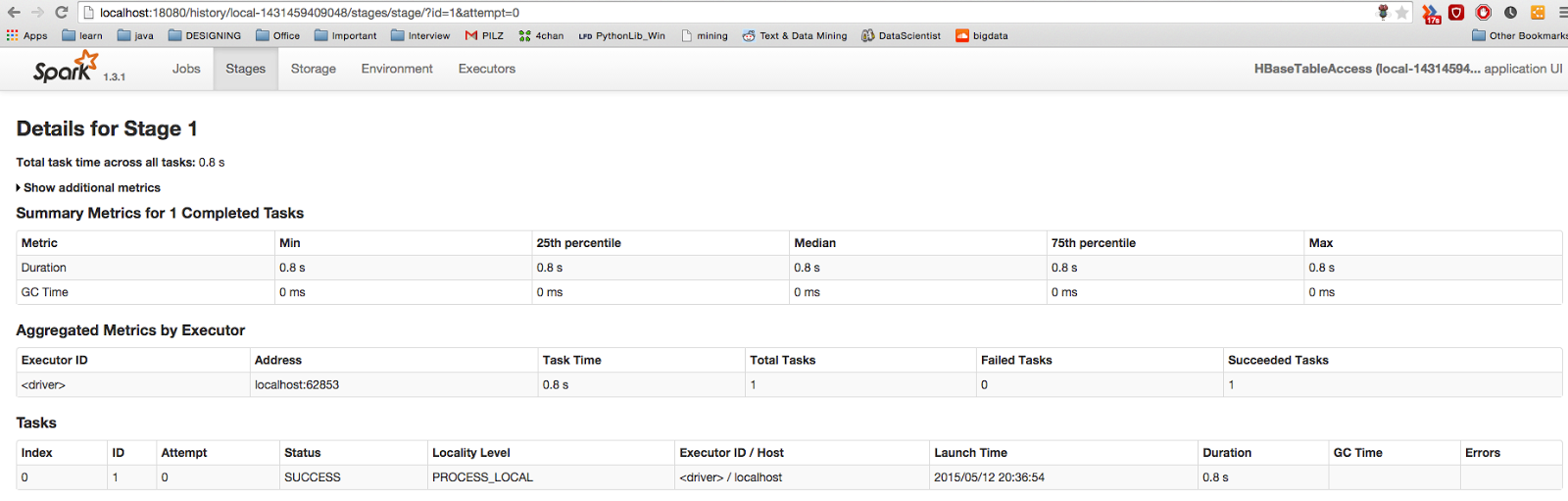
Trouble Connecting Apache Spark with Hbase due to missing classes

Ideally when you try to connect HBase with Apache Spark, in most of the cases, it throws exception like ImmutableBytesWritableToStringConverter or Google Utils not found and various other errors while trying to run.

Almost all belongs to the same family of missing drivers.


To solve it straight forward,


Just go to spark-defaults.conf

update your spark.driver.extraClassPath with required libraries. keep on adding them.

like for missing ImmutableBytesWritableToStringConverter , add spark-examples-1.3.1-hadoop2.4.0.jar.


spark.driver.extraClassPath /Users/abhishekchoudhary/anaconda/anaconda/lib/python2.7/site-packages/graphlab/graphlab-create-spark-integration.jar:/Users/abhishekchoudhary/bigdata/cdh5.2.0/hbase/lib/hbase-server-0.98.6-cdh5.2.0.jar:/Users/abhishekchoudhary/bigdata/cdh5.2.0/hbase/lib/hbase-protocol-0.98.6-cdh5.2.0.jar:/Users/abhishekchoudhary/bigdata/cdh5.2.0/hbase/lib/hbase-hadoop2-compat-0.98.6-cdh5.2.0.jar:/Users/abhishekchoudhary/bigdata/cdh5.2.0/hbase/lib/hbase-client-0.98.6-cdh5.2.0.jar:/Users/abhishekchoudhary/bigdata/cdh5.2.0/hbase/lib/hbase-common-0.98.6-cdh5.2.0.jar:/Users/abhishekchoudhary/bigdata/cdh5.2.0/hbase/lib/htrace-core-2.04.jar:/Users/abhishekchoudhary/bigdata/cdh5.2.0/spark-1.3.1/lib/spark-examples-1.3.1-hadoop2.4.0.jar:/Users/abhishekchoudhary/bigdata/cdh5.2.0/spark-1.3.1/lib/spark-assembly-1.3.1-hadoop2.4.0.jar:/Users/abhishekchoudhary/bigdata/cdh5.2.0/hbase/lib/guava-12.0.1.jar


And one more thing , its actually ultra fast to access Hbase using Spark , so real-time updates


Monday, December 29, 2014

Why did I use BigData Technology (Spark) for Machine Learning (NLP)

BIG DATA WITH NLP 

I am here to do Sentiment Analysis of twitter dataset and trying to make it a generalize platform  irrespective of twitter or any other source , so dimension and size of training data is actually large and it will grow on.

As a developer of Machine Learning, I thought of trying Python as the technology and for trial I was having around 1600000 records from http://help.sentiment140.com/


Why not R?


Well first I found R is not same traditional way of coding so comfort was question but making things in R is extremely easy. So that can't be the only reason to try in python.


Python is nice language and NLTK library made NLP very easy and loads of example are there and at-least NLP is very powerful with nltk library along with that scikit-learn library (machine language algorithms).


Its very easy to code in Python compare to R in my view.

Brilliant support with Hadoop Streaming for python so I will vote up for Python again.

So here I got an opportunity to try something new and thats always exciting :-)

(I am not saying Python is better than R , as I use both of them , in this particular scenario , for me , python stood)

So how to do that ?


Well Sentiment Analysis is not just 1 thing that I get the text and ran algorithm and here we go. Its never like that , once you get data you need to decide polarity on it I mean first need to find 

any statement is positive or negative
Then create a feature set
The find stop words
Then bla bla bla ...
Then finally train it
Then test accuracy
Then finally predict it

I means it has loads of step before reaching the goal so it no way an ordinary task but once you are clear with the concept, its neither tough.

check Text Processing


Whats more ?


So I first tried with small dataset of around 400 records having 100 test records and ran NaiveBayes from nltk


 classifier = NaiveBayesClassifier.train(X_train)  

and it ran in very small time of around 10 sec and then some accuracy test with precision test more 10-20 seconds and thats done.
The file size was approx. 500kb thats all and it took 20 to 30 seconds.


Cool thats brilliant , 30 seconds and all set.
But is it enough ? Are we set ?


Then why do I need Bigdata framework ?

On exploring more I found there is a brilliant sentiment dataset available in sentiment140 and the file size was about 250mb or precisely the records number are 1600000, thats a pretty decent size for getting a proper result of sentiment analysis.

So I was all set and ran the same algorithm with this new dataset or file. The file contains positive and negative statements collected from twitter so I changed the file name and ran the python script.

Damm!!! my system is quite good config even memory exception . What... can't I run this, well no I can't. I tried several times and I tried the same with high config Windows as well as Mac machine and same thing, Memory Error.

So I was left with only one choice , try the same in Bigdata platform and see atleast it must run there and I ran the same program but in Hadoop YARN environment & Spark and finally it ran but at what cost ???
It took more than 14 minutes to finish the job.


So 14 minutes for 1600000 records , but I need to deal with 20 times of this size , how the hell I am gonna do that.
20 * 14 minutes in simple mathematics and that won't happen because resource utilisation , memory factor will anyway raise the time more and more.


So is it really a feasible option?

Now Spark fits here .

Spark has a brilliant library MLlib which contains almost all known popular Machine Learning API's Spark Library
As I already told that I am using NaiveBayes, Spark has already API

So I need to change in the code, because Spark works in the concept of RDD ie resilient distributed dataset RDD Concept

I am surely not gonna explain the changes but I must admit that there were pretty important changes almost everything to parallelise the process the basic concept behind Bigdata framework including Spark.

Now I was set and ran the Spark in my local system and YARn (no cluster) and surprisingly it took around 2.4 minutes and I added more extensive operation on the code and maximum it went till 3.8 minutes. Find below -


Conclusion

In current days, when there is unlimited data source then its very hard to restrict yourself if there are technologies available to handle the size and dimension of data and Spark is an excellent fit for Big Data but in machine learning its not only about running the algorithm but ignoring those now BigData platform or technology stack is actually brilliant source.

So moving on I am going to use Spark for Text processing but I got one more great option GraphLab , so once I try that I will compare Spark and GraphLab and initial research showed me GraphLab is little bit faster than Spark


All my codes are already in github

Proper Sentiment Analysis in Spark
Python NLTK Naive Bayes Example
Analysis in YARN Long Running